Blog
Wheatgrass at home: growing a tray and juicing it


Short answer. To make wheatgrass juice at home, soak wheatgrass seed for a few hours, let it sprout, spread it thickly on a tray of moist soil or coir and cut the grass when it is about 15 to 20 cm tall, usually 7 to 10 days later depending on the weather. Juice it on a horizontal slow juicer such as the Sana 727, 929 or 707, feeding small bundles slowly and alternating them with a piece of apple or cucumber. It tastes strong, so start with a 30 ml shot and chase it with orange, or stir it into a green juice.
On this page
- Why wheatgrass needs a horizontal slow juicer
- What you need to grow wheatgrass
- How to grow wheatgrass at home
- Growing wheatgrass in a South African summer
- How much to grow for one person
- Juicing wheatgrass on a slow juicer
- What does wheatgrass taste like?
- Storing wheatgrass and its juice
- What the research says about wheatgrass
- Food safety for home-grown greens
- Frequently asked questions
Why wheatgrass needs a horizontal slow juicer
Wheatgrass is thin, fibrous and very low in water, which makes it one of the hardest things to juice. A fast-spinning centrifugal juicer doesn’t press thin, dry blades well, and the yield is poor. People who juice wheatgrass every day generally agree on a slow juicer; one long-time wheatgrass drinker on The Rawtarian forum puts the line at 150 rpm or slower.
A horizontal slow juicer suits it best. The auger lies flat and presses the grass along the screen, so the fibres are squeezed rather than tangled.
- Sana 727 Supreme. Use the 40 rpm setting, which Sana gives for root vegetables and fibrous greens, and the fine screen.
- Sana 929 Ultimate. Its slowest speed is also 40 rpm, recommended for concentrated green and vegetable juices, and it has a pressure cap for getting more from fibrous greens.
- Sana 707. It runs at a single low speed of 63 to 75 rpm, and wheatgrass is one of the ingredients Sana names for it.
The hands-free Sana 878 and 818 are built for fruit and bigger batches. The 818 manual does list wheatgrass, cut into pieces 3 cm or shorter, but cutting grass that small for a self-feeding hopper is fiddly. For wheatgrass we would always choose a horizontal, where you can feed a bundle by hand a little at a time.
What you need to grow wheatgrass
- Seed. Look for wheatgrass seed sold for sprouting. Living Seeds sells a 200 g bag of organically grown wheatgrass sprouting seed through Faithful to Nature, and Seeds for Africa sells wheatgrass sprouting seed too. If you already mill your own flour, whole wheat berries will often sprout as well; soak a tablespoon first and check that most of them put out a root within a day or two before you sow a tray. Our home milling guides cover the grain side.
- A shallow tray with drainage holes, plus a second tray or a board to cover it.
- Potting soil or coir (coconut fibre), about 2 to 3 cm deep.
- A spray bottle for misting.
How to grow wheatgrass at home
- Rinse and soak. Rinse the seed well, then soak it in cool water for a few hours. Living Seeds suggests 3 to 6 hours.
- Let it sprout. Drain the seed and leave it in a sieve or jar, covered, out of direct sun. Rinse and drain it twice a day until tiny white roots appear, usually within a day or so.
- Sow thickly. Spread the sprouted seed over the moist soil or coir in a single dense layer, with the seeds touching, and press it down gently.
- Cover for a few days. Mist the seed, then cover the tray to keep it dark and humid. Living Seeds suggests a weighted cover for 2 to 3 days. Check it daily and mist if it looks dry.
- Bring it into the light. Once the shoots are a few centimetres tall, uncover the tray and put it in bright, indirect light. Water once or twice a day so the medium stays damp but never waterlogged.
- Cut at about 15 to 20 cm. In mild weather that takes roughly 7 to 10 days, but it varies with temperature: faster in summer, slower in winter. Cut just above the soil with clean scissors.
A cut tray will often send up a second, thinner crop. We use it once more and then compost the mat.
Growing wheatgrass in a South African summer
Heat makes wheatgrass grow quickly, and mould too. A tray in a warm, still kitchen in December can turn in a day.
- Keep the air moving. A spot near an open window, out of direct afternoon sun, works better than a closed cupboard or a hot windowsill.
- Water less, more often. Damp, not soggy. Pour off any water sitting in the drip tray.
- Water in the morning, so the surface can dry a little through the day.
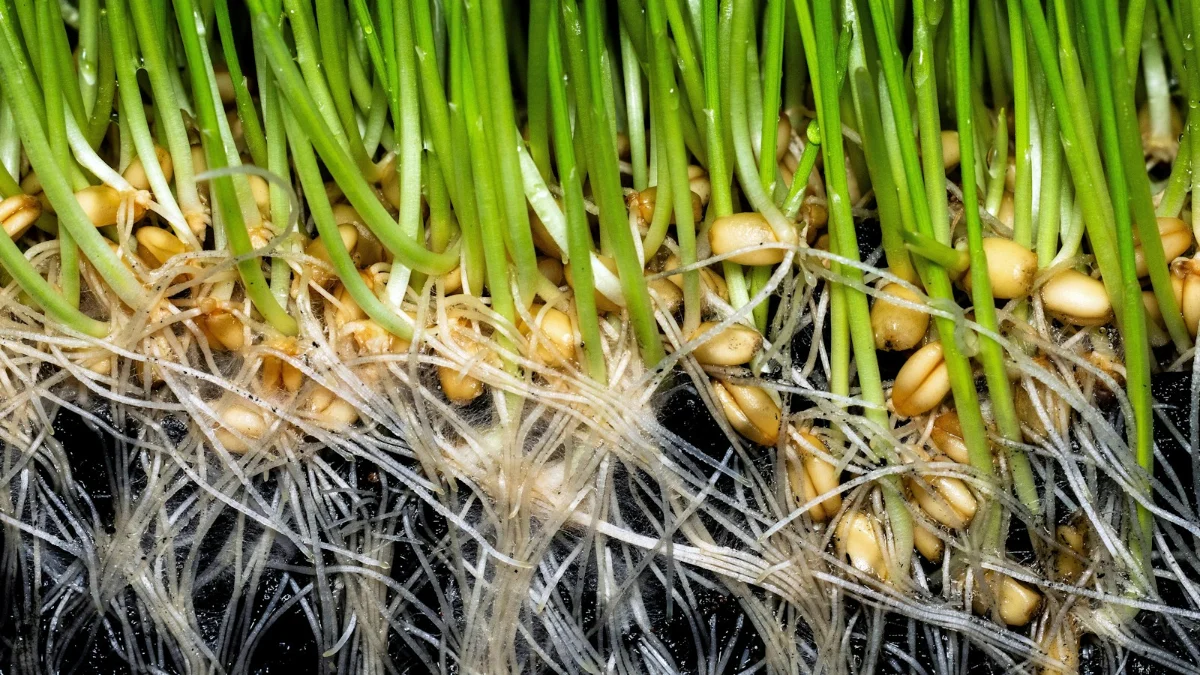
- Know roots from mould. Fine, fuzzy white hairs clinging to the roots are root hairs and are normal. Mould looks like grey or white cobweb spreading over the seeds and soil surface, often with a musty smell. If you see mould, throw the tray out rather than cutting around it.
In winter the opposite applies. Growth slows, so expect closer to two weeks to reach cutting height.
How much to grow for one person
A shot needs more grass than you might expect. As a rough guide, about 300 g of wheatgrass gives 200 to 250 ml of juice, so a 30 ml shot takes a big handful of around 40 g. One person having a small shot most days will get through a modest tray in under a week.
For a steady supply, sow a new tray every three or four days, so there is always one ready to cut, one growing and one just sown. Start small and adjust.
Juicing wheatgrass on a slow juicer
- Fit the fine screen and choose the slowest speed on the 727 or 929.
- Bundle it. Gather a small handful, fold it in half or cut it into shorter lengths, and feed it in as a bundle.
- Feed slowly. Let each bundle clear before adding the next. Pushing in too much at once is a common cause of clogging.
- Alternate with something firm and juicy. A wedge of apple or a length of cucumber between bundles carries the grass through and pushes out the last of the juice.
Wheatgrass and apple shot
Ingredients
Equipment
Method
- Cut the wheatgrass just above the soil, rinse it in a bowl of cold water, shake it dry and discard any yellow blades.
- Fit the fine screen. On the Sana 727 or 929, choose the slowest setting, 40 rpm. The Sana 707 runs at one low speed.
- Gather a small bundle of grass, fold it in half and feed it in slowly. Follow it with a wedge of apple.
- Keep alternating bundles of grass and wedges of apple, letting each one clear before adding the next. Finish with apple.
- Stir, pour into two small glasses and drink soon after making. Rinse the juicer straight away.
Notes
What does wheatgrass taste like?
Strong: intensely grassy, sweet at first with a bitter edge after. Start with 30 ml rather than a full glass, and have a small glass of orange juice ready to follow it.
If you would rather not drink it neat, stir it into a green juice instead. A wheatgrass, cucumber and lemon juice is a gentle way in: juice a small handful of wheatgrass with a whole cucumber, a green apple and half a peeled lemon, and the grass flavour sits in the background. For a fuller green juice, add a shot of wheatgrass to our foundation green juice, and for other small, strong juices see our ginger and turmeric shots.
Storing wheatgrass and its juice
Wheatgrass juice is best drunk soon after you make it. If you have extra, keep it in a small, sealed glass bottle filled to the top in the fridge and drink it within a day.
For longer, freeze it. Pour the juice into an ice cube tray in 30 ml portions, freeze, then move the cubes to a sealed container. Thaw one in the fridge overnight, or drop it into a glass of juice.
The grass itself keeps best growing, so cut only what you need each day.
What the research says about wheatgrass
Wheatgrass has a big reputation and very little research behind it. A small randomised pilot trial in people with ulcerative colitis (23 people randomised, 19 analysed) and an uncontrolled pilot study in patients with thalassaemia (38 enrolled, 16 analysed) are about the extent of it. Studies that small can’t show whether wheatgrass helps either condition, and the bigger claims made for it online aren’t supported by good evidence.
So we make wheatgrass because we like it, it is satisfying to grow, and it adds variety to a diet with plenty of vegetables. If you take regular medication or have a health condition, check with your doctor before making it a daily habit.
Food safety for home-grown greens
Warm, damp trays suit bacteria and mould as well as wheatgrass, and home-made juice isn’t pasteurised.
- Wash your hands before handling the seed, the tray and the grass.
- Start clean. Wash trays and covers in hot, soapy water between batches and use fresh soil or coir each time.
- Discard mouldy trays. Don’t cut around mould; compost the whole tray.
- Cut above the soil, rinse the grass, drink the juice fresh and clean the juicer straight away.
The US Food and Drug Administration notes that untreated juice carries a higher risk of serious illness for young children, older adults, pregnant women and people with weakened immune systems. If that includes you or the person you’re making it for, check with your doctor first.
Made with a Sana juicer


Sana 707 Juicer
R9899,00

Sana 727 Supreme Juicer
Price range: R12999,00 through R14999,00

Frequently asked questions
Can I juice wheatgrass in any juicer?
Not well. Centrifugal juicers spin too fast to press thin, dry blades and give very little juice. A horizontal slow juicer such as the Sana 727, 929 or 707 presses the grass along the screen at low speed, which suits it much better.
How long does wheatgrass take to grow?
Usually about 7 to 10 days from sowing to cutting at 15 to 20 cm, but it depends on temperature. It grows faster in summer heat and can take closer to two weeks in winter.
Can I grow wheatgrass from wheat berries bought for milling?
Often, yes. Whole wheat berries will usually sprout. Soak a tablespoon first and check that most put out a root within a day or two before sowing a full tray. Seed sold for sprouting is the more reliable choice.
How do I tell mould from roots on my wheatgrass tray?
Fine, fuzzy white hairs on the roots are root hairs and are normal. Mould spreads as a grey or white web over the seeds and the surface of the soil and often smells musty. If you see mould, throw the whole tray away.
How much wheatgrass juice should I drink?
There is no established amount. Start with a small shot of about 30 ml, see how it sits with you, and chase it with orange juice or mix it into a green juice if the taste is too strong. If you take medication or have a health condition, check with your doctor first.
Can the Sana 878 or 818 juice wheatgrass?
They are designed for fruit-led juice and bigger batches. The 818 manual lists wheatgrass, cut into pieces 3 cm or shorter, but a horizontal juicer such as the 727, 929 or 707 is the better tool, because you can feed small bundles slowly by hand.
Sources
- Living Seeds wheatgrass sprouting seeds, Faithful to Nature: soaking, sowing and harvest guidance. faithful-to-nature.co.za
- Wheatgrass sprouting seeds, Seeds for Africa. seedsforafrica.co.za
- Wheatgrass discussion, The Rawtarian community: slow juicers for wheatgrass. therawtarian.com
- How to make wheatgrass shots and juice, Alphafoodie: yield per weight and freezing. alphafoodie.com
- Ben-Arye E, et al. Wheat grass juice in the treatment of active distal ulcerative colitis: a randomized double-blind placebo-controlled trial. Scand J Gastroenterol 2002;37(4):444–9. pubmed.ncbi.nlm.nih.gov
- Marwaha RK, et al. Wheat grass juice reduces transfusion requirement in patients with thalassemia major: a pilot study. Indian Pediatrics 2004. indianpediatrics.net
- Talking about juice safety, US Food and Drug Administration. fda.gov
- Sana 818 user manual, Sana Products: preparing leaf and stem vegetables. sanaproducts.com
- Sana 727 Supreme, Sana 929 Ultimate and Sana 707 product pages: speeds and screens. sanastore.co.za · sanastore.co.za · sanastore.co.za