
Blog
Converting Your Favourite Recipes to Fresh-Milled Flour

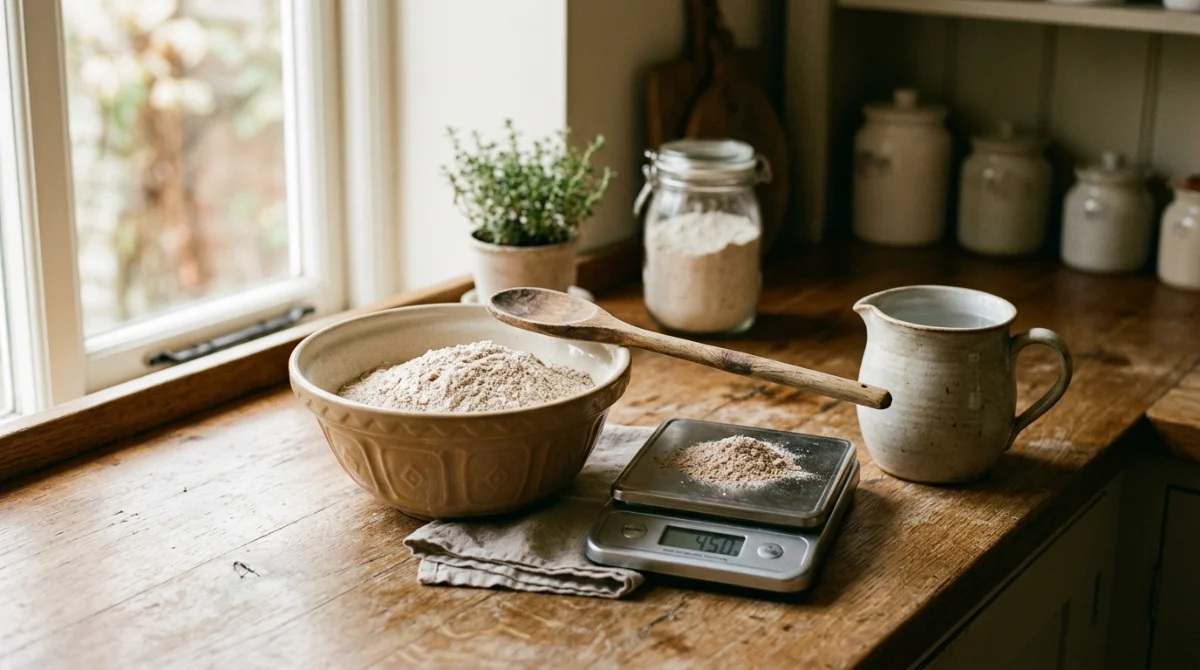
Converting recipes to fresh-milled flour is not a one-for-one swap. The flour will take more water, ferment faster, brown sooner and want far less added fat. The working rule: keep the flour weight exactly the same, add 15 to 20 percentage points more water, cut the yeast or starter by about a third, cut added oil by two-thirds, and drop the oven 10 to 15 °C. Then stop touching the dough for an hour and let it come right on its own.
That last part is the one that catches everybody. Fresh-milled dough looks like wet sand when you mix it and nothing like dough. Thirty to sixty minutes later it is perfectly workable. The beginner’s mistake is to add flour at the exact moment the dough was about to fix itself.
Here is the whole conversion, step by step, with two South African recipes worked through properly at the end.
On this page
- Can I just swap fresh-milled flour 1:1 for shop flour?
- How much extra water does fresh-milled flour need?
- How do I adjust the yeast or the starter?
- Do I need to change the fat, the sugar or the salt?
- How does converting recipes to fresh-milled flour change the mixing?
- How do I adjust baking time and temperature?
- Which recipes convert easily to fresh-milled flour, and which fight back?
- Worked example 1: a standard SA white sandwich loaf
- Worked example 2: a creamed butter cake
- When should I blend instead of going 100%?
- Frequently asked questions
- Milling the right grain for the job
Can I just swap fresh-milled flour 1:1 for shop flour?
By weight, yes: the flour weight stays the same. Everything around the flour changes.
Three things are different about the flour in your hopper compared with the flour in a shop bag:
The bran is still in it, and it is sharp. Freshly milled bran fragments cut the gluten network as it forms; bakers often describe them as little glass shards slicing the strands. That is a big part of why fresh-milled loaves come out flat, and why you handle the dough less, not more.
The germ is still in it, and it carries oil. Roughly 8 to 10% of the germ is oil, and the germ is about 2.5% of the berry. Small numbers, but it means your flour already contains fat, which is why recipes calling for oil need much less of it.
The bran and germ are thirsty. Bran absorbs several times its own weight in water, and it absorbs it slowly, over 30 to 60 minutes rather than 30 seconds. That slowness is the whole reason fresh-milled dough looks wrong at first.
Two bonus differences worth knowing: the enzyme activity is much higher in fresh flour, so doughs ferment faster and crusts brown sooner; and flour straight from the mill is aerated and will settle by roughly 10% in volume over a few hours. Which brings us to the first rule.
Weigh everything. Stop using cups.
A cup of South African cake flour, spooned and levelled, is about 125 g. A cup of fresh-milled flour straight from the mill, still full of air, can be as little as 110 g. Use a cup measure and you will under-deliver flour by 10 to 15% and then wonder why the batter is thin.
If your treasured recipe is in cups, convert it once, write the gram weights on the card, and never look back. Flour is the one ingredient where the conversion really matters.
| Ingredient | 1 cup (250 ml) ≈ |
|---|---|
| SA cake flour, spooned and levelled | 125 g |
| SA bread flour, spooned and levelled | 130 g |
| Fresh-milled whole wheat, straight from the mill | 110 g |
| Fresh-milled whole wheat, settled overnight | 125 g |
| Fresh-milled rye, fine | 105 g |
| Sugar, white | 200 g |
| Butter | 225 g |
How much extra water does fresh-milled flour need?
More than you think, and the amount depends on what you are making. Enriched doughs need less extra because the milk, eggs and butter already carry water.
| What you are making | Typical with shop flour | With fresh-milled | Add roughly |
|---|---|---|---|
| Sourdough hearth loaf | 70–75% | 85–90% | +15 points |
| Yeasted tin loaf | 62–68% | 78–85% | +16 points |
| Pizza dough | 60–65% | 72–80% | +14 points |
| Focaccia | 75–80% | 88–95% | +14 points |
| Flatbread, roti, tortilla | 55–60% | 65–72% | +12 points |
| Enriched / brioche-style | 60–65% | 70–76% | +11 points |
| Pancakes, crumpets, waffles | batter, by feel | — | +20–25% liquid |
| Muffins, banana bread | — | — | +15–20% liquid |
| Scones | — | — | +10–15% liquid |
| Creamed butter cake | — | — | +10–15% liquid |
| Shortcrust pastry | — | — | +10% liquid |
| Biscuits, shortbread | — | — | +5–10% liquid |
Percentages are baker’s percentages: water as a percentage of flour weight. For 500 g flour, 85% hydration means 425 g water.
Hold back 5% of the water. Mix with 80% of your target, then add the last portion during or after the autolyse once you can feel what the flour is actually doing. Grain varies. The same recipe made with one farm’s stoneground wheat and with a bag of hard red from a feed merchant will want different water, and the bag never tells you.
How do I adjust the yeast or the starter?
Downward, in both cases, because fresh-milled flour ferments considerably faster.
Commercial yeast: cut by about 30%. A recipe calling for 7 g instant yeast per 500 g flour becomes 5 g. Alternatively, keep the yeast and cut the times by 25 to 30%, but reducing the yeast gives you more flavour and a much wider margin for error.
Sourdough: cut the prefermented flour hard. A typical white-flour sourdough runs 20% levain, which is about 10% prefermented flour. With fresh-milled, start at 10 to 15% levain, or 5 to 7.5% prefermented flour. Experienced fresh-milled bakers go further; some run as little as 3.5% prefermented flour and still get a full bulk in a normal afternoon. Our guide to starting a sourdough starter with fresh-milled flour covers building one that behaves predictably.
Shorten the cold retard. Refrigeration does not stop fermentation in fresh-milled dough the way it does in white. Enzyme activity carries on at 4 °C. A cold retard that would be a comfortable 12 to 16 hours with bread flour will be over-fermented at 12 hours with fresh-milled. Start at 8 to 10 hours and work up.
And one that feels wrong at first: deliberately under-ferment. Fresh-milled dough that looks properly bulked is usually already past its best. Pull it at roughly 50 to 60% rise rather than doubled, and bank the rest of the gas as oven spring.
Do I need to change the fat, the sugar or the salt?
| Change | Why | |
|---|---|---|
| Added oil or butter (in bread) | Cut by two-thirds, or omit | Germ oils are already in the flour. Extra fat coats the already-fragile gluten and you get a loaf that will not hold its shape. |
| Butter in cakes and pastry | Leave as is | Here the fat is doing structural work, not conditioning gluten. |
| Sugar | Leave as is, but watch the colour | Fresh flour’s higher amylase activity releases more sugars on its own, so things brown faster whatever you do. |
| Salt | Leave at 2% of flour weight | Do not reduce. Salt slows the fast fermentation and tightens a slack gluten network — you need it more here, not less. |
| Baking powder, bicarb | Leave as is | Chemical leavening is unaffected. |
| Vital wheat gluten | Optional, 1–2% of flour weight | A legitimate crutch if your loaves keep collapsing. Not needed once your technique settles. |
How does converting recipes to fresh-milled flour change the mixing?
This is where most of the result actually comes from.
- Autolyse 60 to 90 minutes, minimum. Flour and water only: no salt, no levain, no yeast. This is not optional with fresh-milled flour, because it is the window in which the bran absorbs its water. Some bakers go overnight in the fridge for hard grains.
- Khorasan and other hard ancient grains want an hour at the absolute minimum, and are better with 90 minutes.
- After the levain or yeast goes in, mix 3 to 5 minutes and stop. More mixing degrades the gluten network here rather than building it, because the bran cuts it faster than mixing can develop it. This is the opposite of what you do with bread flour, and it is the hardest habit to break.
- Do not add flour during the first hour. The dough will be wet sand. Leave it. Come back in 40 minutes and it will be dough.
- Replace kneading with folds. Three or four sets of stretch-and-folds at 30-minute intervals through the bulk, gently.
How do I adjust baking time and temperature?
Drop the oven 10 to 15 °C and add 5 to 10 minutes. Fresh-milled bakes brown considerably faster because of the extra available sugars, so a loaf at your old temperature will be dark outside and raw in the middle. If the top gets ahead of you anyway, tent it with foil at the two-thirds mark.
Stop baking by appearance and start baking by internal temperature. It is the most useful change you can make:
| Internal temperature | |
|---|---|
| Lean hearth loaf, sourdough | 96–99 °C |
| Yeasted tin loaf | 93–96 °C |
| Enriched / brioche-style | 88–91 °C |
| Muffins, banana bread | 96–99 °C |
| Butter cake | 96–99 °C |
A R150 instant-read probe will do more for your fresh-milled baking than any other purchase.
Which recipes convert easily to fresh-milled flour, and which fight back?
| Converts beautifully | Converts with work | Fights you |
|---|---|---|
| Pancakes, flapjacks, crumpets | Yeasted tin loaves | Delicate sponge and chiffon cakes |
| Waffles | Sourdough hearth loaves | Angel food cake |
| Muffins, banana bread | Pizza dough | Puff pastry, croissants |
| Scones | Focaccia | Choux |
| Biscuits, rusks, beskuit | Enriched doughs | Swiss roll |
| Flatbreads, roti, tortillas | Ciabatta | Macarons, anything meringue-structured |
| Crumble and crumpet batters | Shortcrust pastry | Very light, very open crumb anything |
| Porridge, roux, thickening | Butter cakes |
The pattern: anything where whole grain flavour is welcome and the structure is forgiving converts easily. Anything whose entire character depends on weak, fine, pale flour and maximum lift will turn out a different cake. Not a bad one, but not the one on the card.
The South African wrinkle
Most South African home-baking recipes are written for cake flour, which runs around 8 to 9% protein: weak, soft and fine. If you convert one of those to fresh-milled hard wheat, you are changing two things at once: refined to whole, and weak to strong. That is why a converted melktert crust can come out tough when the same conversion works fine on a bread recipe.
The fix is to match the grain to the job rather than milling one grain for everything:
| The recipe calls for | Mill this | Note |
|---|---|---|
| Bread flour | Hard red or hard white wheat | Hard white is milder — the easier sell at home |
| Cake flour | Soft wheat, or spelt | Sift to pull the bran out |
| Self-raising flour | Soft wheat + 2% baking powder, 1% salt | Mix fresh each time |
| Semolina / pasta flour | Durum wheat | Coarser setting than bread flour |
| Rye flour | Rye | Mill fine; it is softer and goes faster |
| Mieliemeal, pap | Dry maize | Coarse to medium setting |
Working out how much of each to buy is its own question. EcoHub covers it in how much grain do I need?, and our grain sourcing guide lists the South African suppliers.
Sifting is your other lever for cakes and pastry. A #40 sieve pulls out 5 to 7% of the weight as bran and gives you high-extraction flour; a #30 pulls out 15 to 20% and gets you close to a white flour. Sifting also oxygenates the flour and improves water absorption, so sifted fresh-milled flour often handles better than you would expect. Keep the bran for porridge, bread, rusks or crumble toppings.
Worked example 1: a standard SA white sandwich loaf
The recipe most South African households have on a card somewhere:
| Original | Converted | Why | |
|---|---|---|---|
| Bread flour | 500 g | 500 g fresh-milled hard wheat | Weight unchanged |
| Water | 325 g (65%) | 425 g (85%) | +20 points; hold back the last 25 g |
| Salt | 10 g (2%) | 10 g (2%) | Unchanged |
| Instant yeast | 7 g | 5 g | −29% |
| Sunflower oil | 25 g (5%) | 8 g (1.6%) | Germ oils already present |
| Sugar | 15 g (3%) | 15 g (3%) | Unchanged |
Method changes: autolyse the flour and 400 g of the water for 60 minutes. Add salt, yeast, sugar and oil, mix 4 minutes, working in the last 25 g of water if the dough will take it. Bulk 60 to 75 minutes with two sets of folds, to about 60% rise rather than doubled. Shape, into a tin, prove 45 to 60 minutes. Bake at 200 °C rather than 220 °C for 35 to 40 minutes, to an internal 94 °C.
Expect a loaf about 10% shorter than the white version, with a tighter crumb, a nuttier flavour and far better keeping quality. That’s the trade. For the fully developed version of this loaf, with a scald to keep it soft, see the everyday fresh-milled sandwich loaf.
Worked example 2: a creamed butter cake
| Original | Converted | Why | |
|---|---|---|---|
| Cake flour | 250 g | Mill 270 g soft wheat, sift through a #40 — you will have 251–257 g — use 250 g | Sifting removes 5–7% as bran |
| Sugar | 250 g | 250 g | Unchanged |
| Butter | 250 g | 250 g | Structural — leave it |
| Eggs | 4 | 4 | Unchanged |
| Baking powder | 10 ml | 10 ml | Unchanged |
| Milk | 125 ml | 155 ml | +24% |
Method changes: once mixed, rest the batter 20 minutes before it goes in the tin. It lets the remaining bran hydrate and stops a gritty mouthfeel. Bake at 170 °C rather than 180 °C, and add about 5 minutes. Internal temperature 96 to 99 °C.
Expect a closer, moister, slightly darker cake with real wheat flavour. It will not be a feather-light sponge, and it is not trying to be.
When should I blend instead of going 100%?
Whenever the recipe matters more than the principle. A 70/30 blend (70% fresh-milled, 30% shop bread flour) gets you most of the flavour with most of the structure, and it is the right place to start if you are converting a recipe you actually care about. Our 70/30 first loaf is built around exactly that ratio.
Go 100% once you have the hydration and the timing right on that specific recipe. Working in the other direction, from 100% back down, teaches you less and wastes more flour.
Frequently asked questions
Can I substitute fresh-milled flour 1:1 for shop flour?
By weight, yes: keep the flour weight identical. But add 15 to 20 percentage points more water, cut the yeast or starter by about a third, cut added oil in bread by two-thirds, and drop the oven 10 to 15 °C. Substituted with no other changes, the recipe will fail.
Why is my fresh-milled dough so wet and sticky?
It is not wet; the bran has not finished absorbing its water. Fresh-milled dough goes from wet sand to workable over 30 to 60 minutes. Leave it alone through that window. Adding flour at the 10-minute mark is the most common beginner mistake, and it produces a dry, dense loaf.
How much extra water does fresh-milled flour need?
Roughly 15 to 20 percentage points more than the same recipe with shop flour. A loaf at 65% hydration becomes 80 to 85%. Enriched doughs need less extra, around 11 points, because the milk, eggs and butter already carry water. Hold back 5% of the water and add it during the mix.
Should I use less yeast with fresh-milled flour?
Yes, about 30% less. Fresh flour has much higher enzyme activity and ferments faster. For sourdough, cut the levain from a typical 20% to 10 to 15%. Reducing the leavening rather than shortening the times gives better flavour and a wider margin for error.
Why does my fresh-milled bread burn on top before it is baked through?
Higher enzyme activity releases more sugars, so the crust browns well before the centre is done. Drop the oven 10 to 15 °C, add 5 to 10 minutes, tent with foil at the two-thirds mark, and bake to an internal temperature rather than to a colour: 93 to 96 °C for a tin loaf, 96 to 99 °C for a hearth loaf.
Do I still need the oil in the recipe when using fresh-milled flour?
Mostly not, in bread. The germ is still in your flour and it carries oil, so cut added oil by about two-thirds or leave it out entirely. Extra fat coats an already-fragile gluten network. In cakes and pastry, where butter is doing structural work, leave the fat as written.
Can I use cup measures with fresh-milled flour?
It is the fastest way to wreck a conversion. Flour straight from the mill is aerated, and a cup can weigh as little as 110 g against 125 g for shop cake flour, a 12% shortfall. Convert the recipe to grams once and write the weights on the card.
Which grain should I mill for cakes rather than bread?
Soft wheat, or spelt. Hard bread wheat makes cakes and pastry tough. Sift through a #40 sieve to pull out 5 to 7% of the bran, and keep the bran for porridge or rusks.
Does fresh-milled dough still work with an overnight fridge retard?
Yes, but shorter. Refrigeration does not halt fermentation in fresh-milled dough the way it does with white flour, because enzyme activity continues at 4 °C. Start at 8 to 10 hours rather than the 12 to 16 you would use with bread flour.
Should I start at 100% fresh-milled flour or blend it?
Blend, if the recipe matters. A 70/30 blend of fresh-milled to shop bread flour gives you most of the flavour with most of the structure. Go to 100% once the hydration and timing are dialled in for that particular recipe.
Do I need to add vital wheat gluten to fresh-milled flour?
Not permanently. At 1 to 2% of flour weight it is a reasonable crutch while you learn, especially with spelt or einkorn. Most bakers drop it once their autolyse and mixing are right.
Milling the right grain for the job
Matching the grain to the recipe is most of what this article is about, and it needs a mill that covers the whole range, from coarse semolina for pasta through to fine soft-wheat flour for cake.
Sana grain mills use 85 mm ceramic-corundum stones in solid beechwood, are made in Austria, and carry a 12-year warranty.
- Sana Grain Mill: 360 W, 100 g/min, 850 g hopper
- Sana Grain Mill MAX: 600 W, 200 g/min, 1,200 g hopper
Imported, warranted and supported in South Africa, with spares and service held locally.
