Blog
A High-Fibre Seed Loaf You Can Make in One Bowl

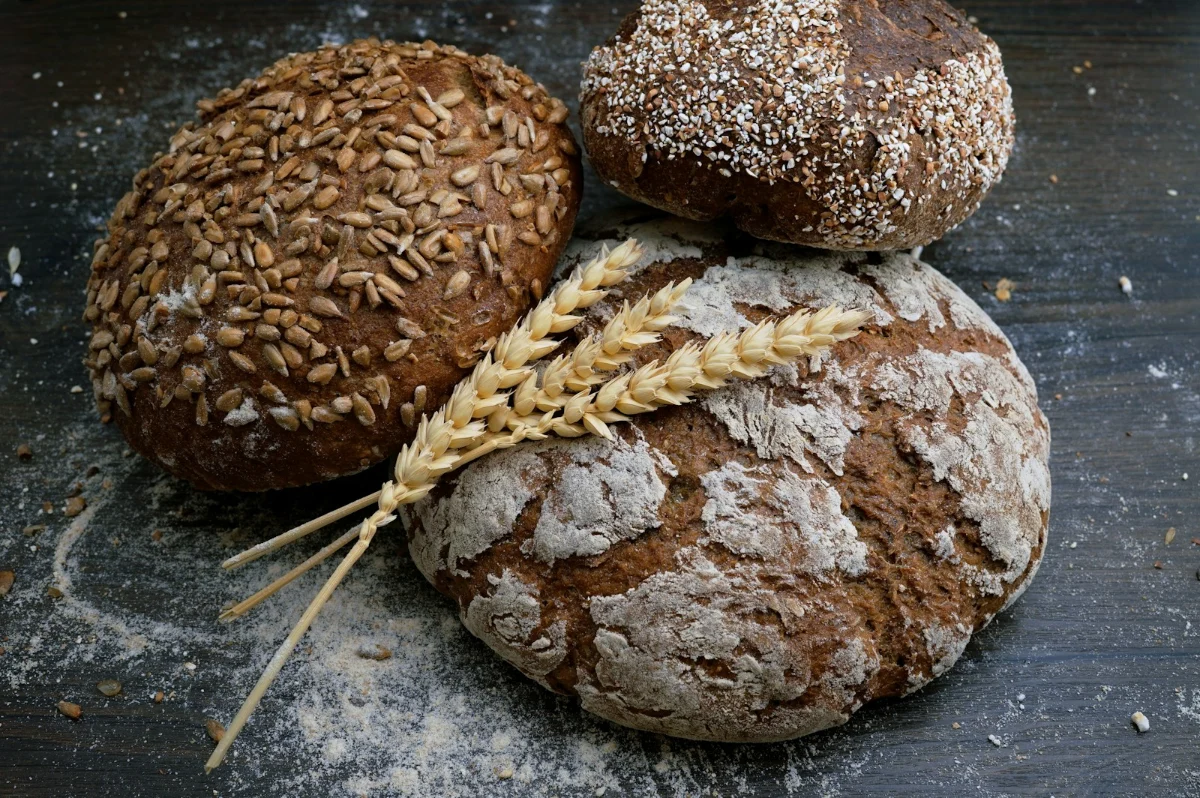
Short answer. This high fibre seed loaf runs to about 4 g of fibre a slice, roughly 7 g per 100 g of baked bread, and it is made in one bowl with a spoon. There is no kneading, no shaping and no stand mixer. You mix a wet dough, let it rise in the tin, and bake it long and slow.
The sums are set out below so you can check them. They are worth checking, because “high fibre” is a phrase that gets used loosely on bread packaging and it has an actual threshold behind it in South Africa.
On this page
What counts as a high-fibre bread in South Africa?
The Regulations relating to the Labelling and Advertising of Foodstuffs (R. 146 of 2010) set the thresholds. Analysed by the AOAC method, a food may be described as a “source of” fibre at 3 g per 100 g and “high in” fibre at 6 g per 100 g. By the Englyst method the figures are 2.4 g and 4.8 g. The method has to be stated, and only the prescribed wording may be used.
This loaf works out at about 7.2 g per 100 g of baked bread. That clears the 6 g bar, with the caveat that the figure is a calculation from published composition data rather than a laboratory analysis of your loaf, and the regulation governs labelled products rather than what you bake at home. It is a yardstick, not a claim on a packet.
For context, the World Health Organization’s 2023 carbohydrate guideline recommends at least 25 g of naturally occurring dietary fibre a day for adults. Two slices of this loaf come to about 8 g, so roughly a third of the day from breakfast.
Which seeds, and why these four?
Four seeds, chosen for fibre per gram, for what they do to the crumb, and for being on the shelf of any South African supermarket.
| Seed | Amount | Fibre per 100 g | Fibre contributed | What it does in the loaf |
|---|---|---|---|---|
| Linseed (flaxseed) | 40 g | 27.3 g | 10.9 g | By far the most fibre per gram, and the mucilage it releases holds water and keeps the crumb moist |
| Sunflower kernels | 60 g | 7.2 g | 4.3 g | Bulk, softness, mild flavour that children accept |
| Sesame | 30 g | 11.8 g | 3.5 g | Flavour, and the crust |
| Pumpkin seeds | 50 g | 5.08 g | 2.5 g | Colour, bite, and a good protein contribution |
Fibre values are USDA FoodData Central. The seeds together contribute 21.3 g. The 400 g of fresh-milled wholemeal flour contributes 42.8 g, so the seeds add about half as much again on top of the flour.
Do not put any of these through the mill. Sunflower, sesame and linseed are oily, and oily seeds clog a stone mill and leave residues in the stones that can go rancid. They go into this loaf whole, which is what you want anyway: whole seeds in the crumb are the texture of the thing.
One caveat on the linseed. A whole linseed passes through the gut largely intact, so if you are after the omega-3 oils rather than the fibre, crack the seeds in a mortar or a spice grinder just before mixing. For the fibre it makes little practical difference, and the mucilage works either way once the seeds have soaked.
How fine should I mill for this loaf?
Medium, not fine. This is one of the few breads where a slightly coarser grind is an advantage: the dough is wet enough that bran does not need to be tamed, and a coarser flour gives the crumb more character.
On a Sana mill, set it about two notches back from where the stones touch. Milling 400 g takes about four minutes on the 360 W mill and two on the MAX. Let the flour cool for ten minutes before mixing, because flour straight off the stones is warm and will push the rise along faster than the timings here assume. If you want the full picture on grind settings and what the stones are doing, EcoHub has the reference piece.
Hard red wheat is good here. Its stronger flavour, which is a problem in a children’s sandwich loaf, sits well against the seeds.
The recipe
One loaf in a 1 kg (2 lb) tin, about 22 × 11 × 7 cm. Finished weight around 885 g, which slices into 16.
Total time about 3 hours 30 minutes, of which 15 minutes is work.
The soaker
| Ingredient | Weight |
|---|---|
| Linseed | 40 g |
| Sesame seeds | 30 g |
| Water, warm | 150 g |
The dough
| Ingredient | Weight |
|---|---|
| Fresh-milled wholemeal flour | 400 g |
| Sunflower kernels | 60 g |
| Pumpkin seeds | 50 g |
| The soaker | all of it |
| Water, lukewarm | 250 g |
| Honey | 20 g |
| Fine salt | 10 g |
| Instant dry yeast | 7 g |
Extra sesame or sunflower seeds for the top.
Totals: 400 g flour · 180 g seeds · 400 g water · dough weight about 1,017 g.
Method
1. Make the soaker, 2 minutes plus 30 minutes standing. Stir the linseed and sesame into the 150 g of warm water. It will thicken into something between a paste and a gel as the linseed releases its mucilage. Leave it while you mill.
2. Mill the flour, 4 minutes. 400 g of hard wheat on a medium setting. Cool for ten minutes.
3. Toast the sunflower and pumpkin seeds, 6 minutes. Dry pan over medium heat, shaking often, until they smell nutty and the pumpkin seeds start to pop. Optional, and worth the six minutes. Let them cool.
4. Mix, 4 minutes. Put the flour, salt and yeast in a large bowl and stir them together. Add the soaker, the 250 g of water and the honey, and mix with a sturdy spoon or a dough whisk until there is no dry flour left. Fold in the toasted seeds.
The dough will be thick, sticky and spoonable, closer to a very stiff porridge than a bread dough. That is correct. Resist the urge to add flour.
5. Rest, 20 minutes. Cover the bowl. The bran and the seeds take up more water in this time and the mixture firms noticeably.
6. Into the tin and rise, 75 to 90 minutes. Grease the tin well and scrape the dough in. Wet the back of a spoon and smooth the top flat, then scatter sesame or sunflower seeds over it and press them in lightly.
Cover loosely and leave somewhere warm until the dough has risen to about 1 cm below the rim of the tin. At 24 to 26 °C this takes 75 to 90 minutes. Do not wait for it to crown over the rim as you would with a kneaded loaf: this dough has no gluten structure to speak of, and if it over-rises it sinks in the oven.
Preheat to 200 °C while it rises.
7. Bake, 60 to 65 minutes. 200 °C for the first 15 minutes, then down to 180 °C for a further 45 to 50 minutes.
A wet, dense loaf needs a long bake, and the clock is not enough on its own. Probe the centre: you want 96 to 98 °C. Anything below 94 °C and the middle stays gummy however good the crust looks. If the top is browning too fast at any point, lay a sheet of foil over it and carry on.
8. Cool properly, 3 hours. Turn it out immediately onto a rack. This loaf needs longer than a standard tin loaf before you cut it, because there is so much water in it. Three hours, and overnight is better. A high-hydration loaf cut warm goes claggy, which people mistake for underbaking.
What a slice gives you
| Nutrient | Per slice (16 slices, about 55 g) | Per 100 g |
|---|---|---|
| Dietary fibre | about 4.0 g | about 7.2 g |
Calculated from USDA FoodData Central composition values for the ingredients listed, with a 13% baking loss assumed. Your flour, your seeds and your oven will all move it a little.
Keeping it
- Two days in a cloth bag or cut side down on a board. The seeds and the linseed mucilage keep it moist longer than a plain wholemeal loaf.
- Then slice and freeze. It toasts straight from the freezer.
- Never the fridge. Bread stales faster at fridge temperature than on the counter.
- Store the seeds themselves in the freezer if you buy them in bulk. Sunflower and linseed are high in unsaturated oil and go rancid at room temperature over a few months, which is the most common reason a seed loaf tastes bitter. The grain is a different matter, and our guide to storing grain and fresh-milled flour covers it.
Variations worth making
- Rye and seed. Replace 100 g of the wheat with fresh-milled rye. Darker, denser, and it keeps a day longer. Rye berries are available from several of the suppliers in our grain sourcing guide.
- Sourdough version. Replace the yeast with 120 g of active starter at its peak and drop the water by 60 g. Bulk the dough in the bowl for 3 to 4 hours before it goes into the tin, then give it 2 to 3 hours in the tin. Our sourdough starter guide covers getting a starter to the point where it can carry a loaf this heavy.
- More seeds. You can push the seeds to 220 g before the loaf stops holding together. Above that it crumbles when sliced.
Where this sits in the library
If you want a soft loaf for sandwiches rather than a dense one for toast and cheese, the everyday fresh-milled sandwich loaf is the one to bake. If you are new to milling altogether, start with the 70/30 first loaf, and if you are moving children across from white bread, getting your family onto whole-grain bread sets out the steps. And if you want to know whether fresh milling actually changes the nutrition rather than the flavour, EcoHub has been through the evidence, including the parts that do not favour home milling.
High fibre seed loaf with fresh-milled flour
Ingredients
Equipment
Method
- Soaker. Stir the linseed and sesame seeds into 150 g of warm water and leave for 30 minutes, until thickened by the linseed mucilage.
- Mill. Mill 400 g of hard wheat on a medium setting, about two notches back from where the stones touch, and let the flour cool for ten minutes.
- Toast the seeds. Toast the sunflower kernels and pumpkin seeds in a dry pan over medium heat for about six minutes, shaking often, then cool. Optional.
- Mix. Stir the flour, salt and yeast together. Add the soaker, 250 g of water and the honey and mix with a spoon until no dry flour remains. Fold in the toasted seeds. The dough is thick and spoonable rather than kneadable.
- Rest. Cover and rest 20 minutes, during which the bran and seeds take up more water and the mixture firms.
- Into the tin. Scrape into a well-greased 1 kg loaf tin, smooth the top with a wet spoon, and scatter extra seeds over, pressing them in lightly.
- Rise. Cover loosely and rise 75 to 90 minutes at 24 to 26 °C, until the dough reaches about 1 cm below the rim. Do not let it crown above the rim. Preheat the oven to 200 °C.
- Bake. Bake at 200 °C for 15 minutes, then at 180 °C for a further 45 to 50 minutes, until the centre reads 96 to 98 °C. Cover with foil if the top browns too quickly.
- Cool. Turn out immediately onto a rack and cool for at least three hours, or overnight, before slicing.
Notes
Made with a Sana grain mill
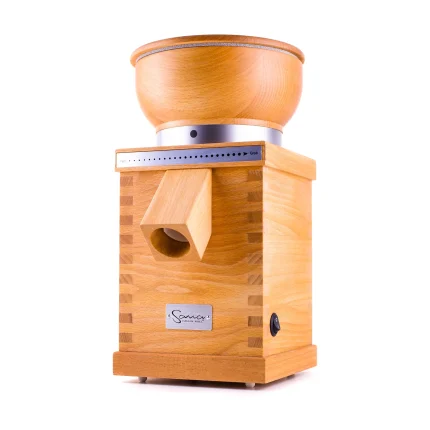
Every recipe in our grain mill recipe collection starts with flour milled at home on a Sana stone mill. Both models use 85 mm ceramic-corundum stones in a solid beechwood housing, are made in Austria and carry a 12-year warranty, with spares and support here in South Africa.
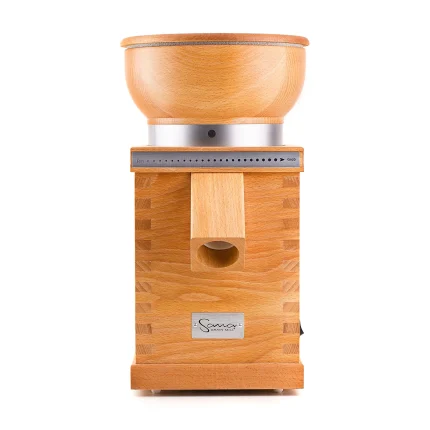
Sana Grain Mill
Original price was: R14800,00.R10999,00Current price is: R10999,00.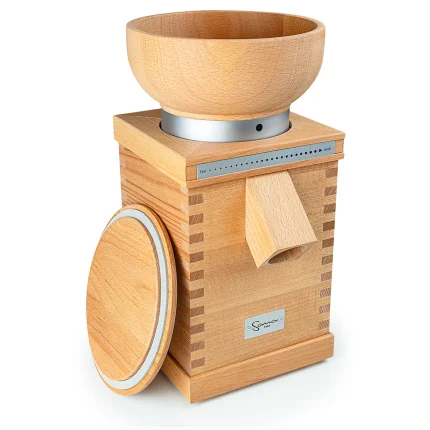
Sana Grain Mill MAX – 600W
Original price was: R18999,00.R15999,00Current price is: R15999,00.Frequently asked questions
What makes a bread high in fibre in South Africa?
Under the Regulations relating to the Labelling and Advertising of Foodstuffs (R. 146 of 2010), a food analysed by the AOAC method may be described as a “source of” fibre at 3 g per 100 g and “high in” fibre at 6 g per 100 g. By the Englyst method the thresholds are 2.4 g and 4.8 g. The analytical method must be stated on the label, and only that prescribed wording may be used.
How much fibre is in a slice of this seed loaf?
About 4 g a slice, cutting the loaf into 16, or about 7.2 g per 100 g of baked bread. That is a calculation from USDA FoodData Central composition values for the flour and the four seeds, assuming a 13% loss of weight to evaporation during baking. It is not a laboratory analysis of your loaf.
Can I mill seeds in a stone grain mill?
No. Sunflower, sesame, linseed and other oily seeds clog the stones and leave oily residues that can turn rancid. Put them into the dough whole. A stone mill is for dry cereal grains and pulses.
Should I grind the linseed for this loaf?
Only if you want the omega-3 oils, in which case crack the seeds in a mortar or a spice grinder immediately before mixing, not in the mill. Whole linseed passes through the gut largely intact, but for the fibre contribution and for the mucilage that keeps the crumb moist, whole seeds soaked in water work perfectly well.
Why is my seed loaf gummy in the middle?
Almost always one of two things. The centre never reached 96 °C, which a long bake at a lower temperature fixes, or the loaf was cut before it had cooled for three hours. This dough carries a great deal of water, and a high-hydration loaf sliced warm goes claggy in a way that looks like underbaking.
Do I need to knead this dough?
No. It is too wet to knead and there is not much gluten structure to build. Mix until no dry flour remains, fold the seeds in, rest for twenty minutes and spoon it into the tin. The structure comes from the bran, the seeds and the soaked linseed rather than from a gluten network.
How fine should I mill the flour for a seed loaf?
Medium rather than fine, about two notches back from where the stones touch. The dough is wet enough that coarse bran is not a problem, and a slightly coarser flour gives the crumb more character. Let the flour cool for ten minutes before mixing.
Why did my seed loaf sink in the oven?
It over-rose in the tin. A no-knead seed dough has little gluten structure to hold itself up, so it should go into the oven when it has risen to about 1 cm below the rim, not when it has crowned above it. Warm flour straight from the mill also speeds the rise, which catches people out.
Why does my seed bread taste bitter?
Usually the seeds rather than the flour. Sunflower kernels and linseed are high in unsaturated oil and go rancid within a few months at room temperature. Buy them in quantities you will finish, keep them in the freezer, and smell them before they go in. Fresh-milled wholemeal flour that has been standing for weeks can also pick up a flat, stale note.
Mill it on a Sana
Sana mills are made in Austria. We import them into South Africa directly, so the warranty, the spares and the support all sit here rather than in Europe.
- Sana Grain Mill: 360 W, 100 g/min, 850 g hopper, 85 mm ceramic-corundum stones, beechwood housing. R10,999.
- Sana Grain Mill MAX: 600 W, 200 g/min, 1,200 g hopper. R15,999, down from R18,999.
Prices correct at October 2026. More in the home-milling library.
Sources
- Composition values: USDA FoodData Central, April 2026 release. Wheat flour, whole-grain, FDC 168893 (10.7 g fibre per 100 g); flaxseed, FDC 169414 (27.3 g); sunflower seed kernels, raw, FDC 2515381 (7.2 g); sesame seeds, whole, dried, FDC 170150 (11.8 g); pumpkin seeds (pepitas), raw, FDC 2515380 (5.08 g).
- South Africa, Department of Health. Regulations relating to the Labelling and Advertising of Foodstuffs, Notice R. 146 of 2010, regulation 52(10) and Table 1 Part B: dietary fibre content claims, AOAC and Englyst thresholds.
- World Health Organization (2023). Carbohydrate intake for adults and children: WHO guideline. At least 25 g of naturally occurring dietary fibre a day for adults.