Blog
A Dense Rye Loaf With No Added Sugar, Made With Fresh-Milled Rye

Short answer. A no sugar rye bread is a 100% wholegrain rye loaf raised by a rye sour rather than yeast, mixed wet, baked in a tin, and left a full day before it is cut. Nothing sweet goes into it. Most rye recipes carry molasses, malt or honey, and most of the time that is there to cover a flat flavour rather than to make the bread work. Fresh-milled rye does not need the help.
It is also the loaf that behaves least like wheat bread, so it is worth understanding before you mix it. The sourdough is not a style choice. Rye needs the acid.
On this page
- Why does rye bread need a sourdough rather than yeast?
- Does rye bread lower blood sugar?
- Which rye, and where do you buy it in South Africa?
- How fine should I mill rye?
- The recipe
- Why is my rye loaf gummy inside?
- Keeping it
- Variations worth making
- Where this sits in the library
- Frequently asked questions
- Mill it on a Sana
Why does rye bread need a sourdough rather than yeast?
Two things about rye flour make it a different proposition from wheat.
The first is structure. Rye has very little of the protein that forms a gluten network, so a rye dough is held together by pentosans instead, a family of soluble fibres that rye carries in far greater quantity than wheat. Pentosans hold water rather than trapping gas, which is why a rye loaf is dense and close rather than open. Dropping the pH of the dough makes those pentosans more soluble and lets them absorb more water, which is what gives a well-made rye loaf its elastic, sliceable crumb.
The second is enzymes, and this is the part that decides whether your loaf works. Rye flour has higher alpha-amylase activity than wheat flour, and rye starch gelatinises at a lower temperature than wheat starch. The two ranges overlap: the enzyme is at its most active exactly when the starch is at its most vulnerable, early in the bake. Left to it, the amylase takes the starch framework apart faster than the bake can set it, and you get a loaf with a damp, sticky, sometimes hollow crumb and a crust that lifts away from it. The IREKS Compendium of Baking Technology, an industry reference for commercial rye baking, puts the alpha-amylase pH optimum at 5.0 to 5.5. A sour takes the dough below that, and the enzyme slows down.
That is the whole reason this recipe uses a rye sour. Yeast alone gives you gas but no acid, and in a 100% rye loaf gas without acid is how you get a gummy brick.
Does rye bread lower blood sugar?
Not on its own, and the research here is clearer than the shelf talkers suggest.
A 2025 systematic review and meta-analysis in Nutrition & Metabolism pooled 31 randomised controlled trials covering 922 people. Across those trials, eating rye had no significant effect on fasting glucose, on glucose after a meal, on fasting insulin, or on insulin after a meal. The one pooled result that did reach significance was a lower insulin area under the curve, which is total insulin released across the hours after eating. The authors call that pattern of unchanged glucose with lower insulin the “rye factor”, and they say in the same breath that the clinical significance of the reduction is not clear and that further prospective studies are needed.
So rye bread is not a treatment for anything. What this loaf does give you is a lot of fibre, no added sugar, and a slice that is dense enough that one is usually enough. Those are worth having on their own terms.
Two further points, because they matter more than the bread does:
- If you have diabetes or prediabetes, the loaf is a detail inside a plan. Portion size, what you eat alongside it, and your own glucose readings will tell you more than any study. That conversation belongs with your doctor or a registered dietitian, not with a recipe page.
- None of this is about the milling. Fresh milling changes the flavour and the keeping of flour, not the glucose response. EcoHub has been through that evidence, including the parts that do not favour home milling.
A note on nutrition: South African bread flour and maize meal are fortified by law with iron, zinc, folic acid and B vitamins. Rye is not, and nor is flour you mill yourself. A home-milled rye loaf is higher in fibre than white bread but carries no added folic acid, which matters if you are pregnant or relying on fortified staples. Keep taking what you have been told to take.
Which rye, and where do you buy it in South Africa?
Whole rye berries, not rye flour. Rye flour on a shelf is usually sifted to some degree, and the point of milling at home is that you get the whole kernel.
Rye is easier to find locally than people expect. Several of the suppliers in our grain sourcing guide stock it alongside their wheat. For a loaf a week you want about 2 kg at a time.
There is one rule about rye that does not apply to wheat, and it comes from Sana’s own manual: rye grain needs to be stored at least six months after harvest before it is ground. Freshly harvested rye has even higher enzyme activity than settled rye, and it will give you the sticky crumb described above no matter how good your sour is. If you are buying from a farm directly rather than through a shop, ask when it was harvested.
How fine should I mill rye?
Fine, and it mills easily. Rye kernels are softer than hard wheat, so they go through faster and cooler, and a fine setting gives you flour rather than the meal you would get from the same setting on a hard red wheat.

Set the mill one notch back from where the stones just touch. You need 500 g of rye flour for this loaf, which is five minutes on the Sana Grain Mill at 100 g a minute and two and a half on the MAX. Let the flour stand for ten minutes before you mix, because flour straight off the stones is warm and will shorten the timings below.
Mill the sour’s 150 g the evening before and the dough’s 350 g in the morning, or mill all 500 g at once and keep the rest in a sealed jar overnight. Either works. If you want the reasoning on how long milled flour keeps, we have a separate piece on storing flour and grain.
The recipe
One loaf in a 1 kg (2 lb) tin, about 22 × 11 × 7 cm. Baked weight around 855 g, which cuts into 18 thin slices.
Across two days. About 25 minutes of work, 12 hours for the sour, 3 hours in the tin, 80 minutes in the oven, then a full day of rest before you cut it.
The rye sour, the evening before
| Ingredient | Weight |
|---|---|
| Active rye or wheat starter | 30 g |
| Freshly milled wholegrain rye flour | 150 g |
| Water at about 30 °C | 150 g |
The dough, the next morning
| Ingredient | Weight |
|---|---|
| The rye sour | all of it, 330 g |
| Freshly milled wholegrain rye flour | 350 g |
| Water at about 35 °C | 290 g |
| Fine salt | 10 g |
| Caraway seeds, optional | 6 g |
Totals: 515 g flour including the starter’s share, 455 g water, hydration about 88%. Dough weight about 980 g.
Method
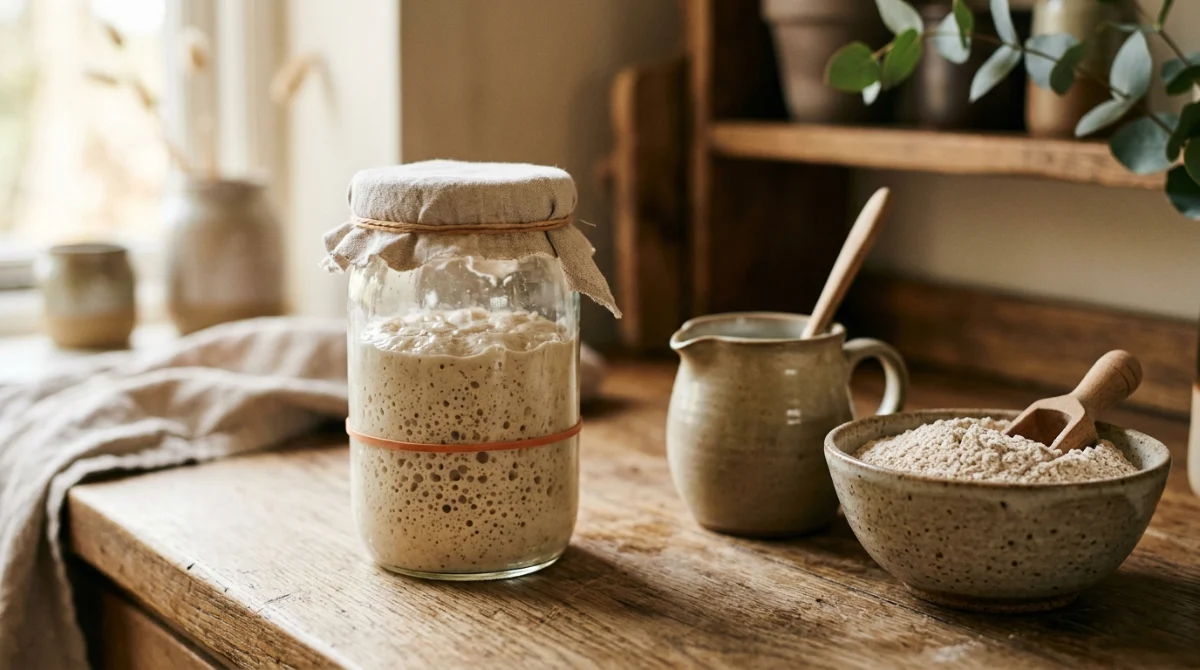
1. Build the sour, 5 minutes plus 10 to 12 hours. Mix the starter, the 150 g of rye flour and the 150 g of warm water into a thick paste. Cover and leave somewhere cool, 18 to 22 °C, for 10 to 12 hours. Overnight on a kitchen counter in a Highveld summer is too warm; find a cooler spot or shorten it to 8 hours. It is ready when the surface is domed and bubbled and it smells sharp and fruity rather than sweet.
2. Mill the dough flour, 4 minutes. 350 g of rye on a fine setting. Let it cool for ten minutes.
3. Mix, 8 minutes. Put the sour, the flour, the 290 g of warm water and the salt in a large bowl. Stir with a sturdy spoon or a dough whisk until there is no dry flour anywhere, then keep going for another three or four minutes. You are not developing gluten, because there is none to develop. You are getting water into the pentosans and the bran evenly, and that takes a bit of work. Stir the caraway in now if you are using it.
The mixture will be sticky and heavy, closer to a tile adhesive than a bread dough, and it will cling to everything. That is correct for 100% rye. Do not add flour to make it behave.
4. Straight into the tin, 3 minutes. There is no bulk ferment and no shaping. Grease the tin well, scrape the dough in with a wet spatula, and push it into the corners. Wet the back of a spoon and smooth the top, then dust it lightly with rye flour.
5. Proof, 2.5 to 3.5 hours. Cover loosely and leave at 24 to 26 °C. The loaf is ready when it has risen by about half, the surface has gone domed and matte, and fine cracks have appeared across the top. The cracks are the signal to bake. Rye does not pass the poke test the way wheat does, so watch the surface rather than the clock. Do not let it go past that point: an over-proofed rye loaf collapses in the oven and there is no gluten structure to catch it. Start preheating to 230 °C once the loaf has risen by about a third, so the oven is fully hot by the time the cracks appear.
6. Bake, 75 to 80 minutes. Cover the tin loosely with foil and bake at 230 °C for 20 minutes. Take the foil off, drop the oven to 180 °C, and bake for a further 55 to 60 minutes. Then probe the centre. You want 96 to 98 °C. A dense rye loaf at 92 °C looks finished from the outside and is raw starch in the middle, so this is the bake where a probe thermometer matters most.
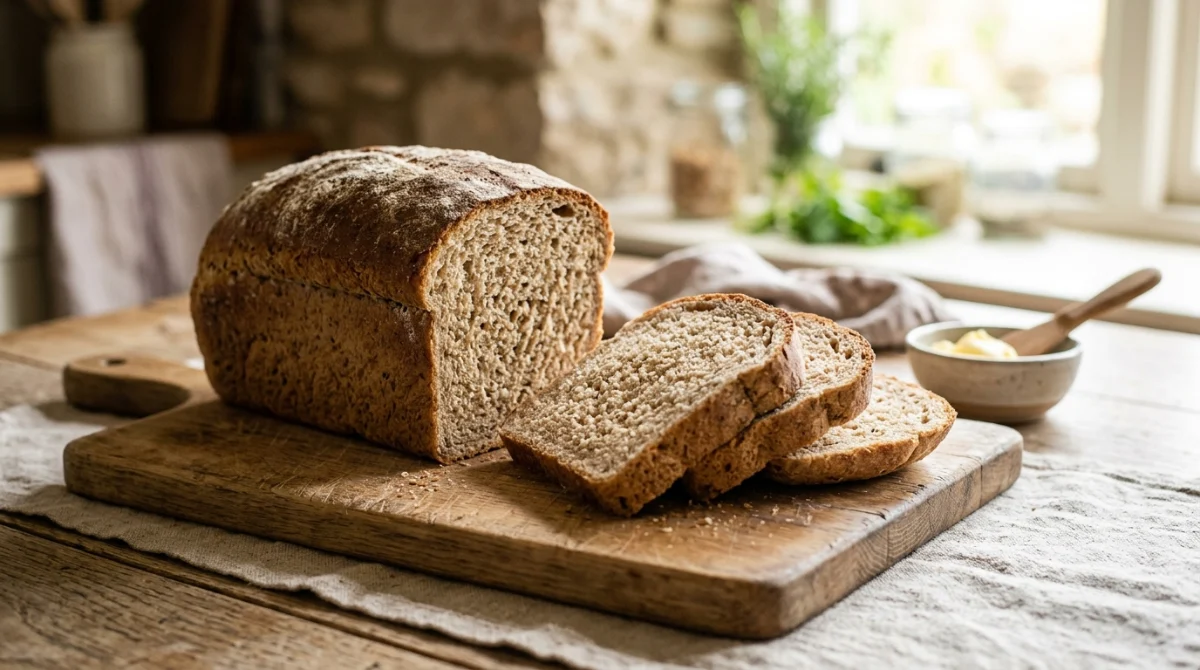
7. Rest for a full day before cutting. Turn it out onto a rack straight away and leave it, uncovered, for at least 12 hours and preferably 24. This is not a nicety. The starch in a rye loaf is still setting for hours after it leaves the oven, and a rye bread cut warm is gummy, sticks to the knife, and will convince you the recipe is wrong. Wrap it in a cloth once it is cold if you are leaving it the full day.
No sugar rye bread with fresh-milled rye flour
Ingredients
Equipment
Method
- Build the sour. Mix the starter, 150 g rye flour and 150 g water at about 30 °C into a thick paste. Cover and leave at 18 to 22 °C for 10 to 12 hours, until domed, bubbled and sharp-smelling.
- Mill. Mill 350 g rye on a fine setting and let the flour cool for 10 minutes.
- Mix. Stir the sour, flour, 290 g water at about 35 °C and salt until no dry flour remains, then 3 to 4 minutes more. Stir in the caraway if using. Do not add flour; the paste should be sticky and heavy.
- Into the tin. Scrape into a well-greased 1 kg loaf tin with a wet spatula, smooth the top with a wet spoon and dust with rye flour.
- Proof. Cover loosely and proof 2.5 to 3.5 hours at 24 to 26 °C, until risen by about half with fine cracks across a matte, domed top. Preheat the oven to 230 °C.
- Bake. Bake covered loosely with foil at 230 °C for 20 minutes, then uncovered at 180 °C for 55 to 60 minutes, until the centre reads 96 to 98 °C.
- Rest. Turn out onto a rack and leave uncovered for at least 12 hours, preferably 24, before slicing thinly.
Notes
What a slice gives you
| Per slice (18 slices, about 47 g) | Per 100 g | |
|---|---|---|
| Dietary fibre | about 4.3 g | about 9.1 g |
| Added sugar | none | none |
Calculated from USDA FoodData Central composition values for rye grain, assuming a 13% loss of weight to evaporation in the oven. Your rye, your oven and how thin you slice will all move it. Two slices come to about 8.6 g of fibre, roughly a third of the 25 g a day the World Health Organization recommends for adults.
Per 100 g this clears the South African threshold for a high-fibre food comfortably. The seed loaf article sets out what those labelling thresholds actually are and where they come from.
Why is my rye loaf gummy inside?
Four causes, in the order they are likely.
- You cut it too soon. By a wide margin the most common one. Give it 24 hours.
- It came out under 96 °C. Put it back. A rye loaf will take another 15 minutes at 170 °C without suffering.
- The sour was not sour enough. A young or sluggish sour does not drop the pH far enough to slow the amylase down, so the starch gets taken apart in the oven. Feed the starter twice a day for two days before you bake, and build the sour from a starter that has doubled recently.
- The rye was too fresh. New-season rye straight off a farm has enzyme activity that a normal sour cannot hold. This is the six-month rule above.
Keeping it
- A week, easily, wrapped in a cloth or in a paper bag inside a plastic bag, cut side down. Rye keeps far longer than wheat bread because of the acid and the water the pentosans hold. Day three is arguably better than day one.
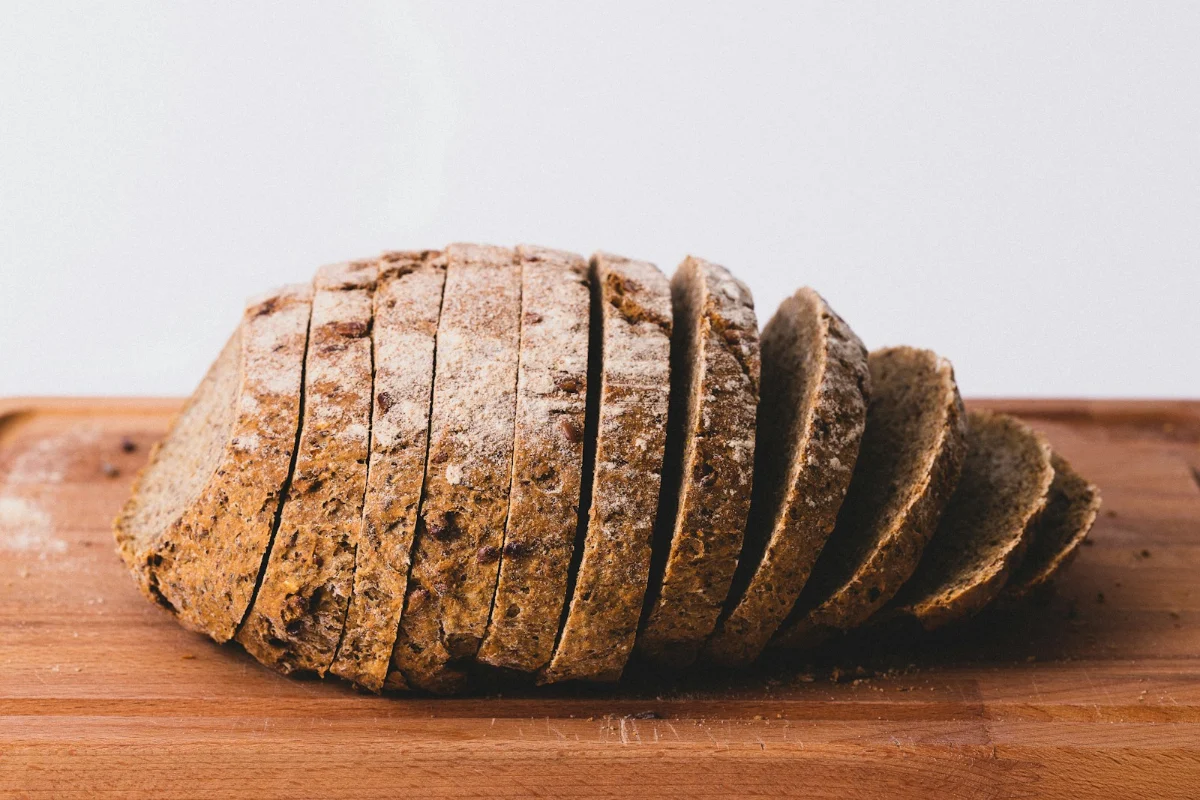
- Slice thin. 5 mm, not 15 mm. A thick slice of 100% rye is heavy going; a thin one with butter and cheese is a different food.
- Freeze it sliced if you want it to last beyond a week. It toasts straight from frozen.
- Not the fridge. Bread stales faster at fridge temperature than on the counter.
Variations worth making
- An 80/20 for a lighter loaf. Replace 100 g of the rye in the final dough with fresh-milled wheat. You get a slightly taller, softer loaf and the dough is marginally easier to handle. Anything above about 30% wheat and you should start treating it as a wheat recipe, which means kneading and a different schedule.
- Seeds. 80 g of sunflower kernels or pumpkin seeds, stirred in at the mix. Do not put them through the mill: oily seeds clog stones and leave residues that can go rancid.
- A soaker for a moister crumb. Soak 80 g of cracked rye (your own, milled on the coarsest setting) in 120 g of boiling water for 4 hours, then add it at the mix and drop the dough water by 80 g.
- Caraway, or not. 6 g is a traditional, assertive amount. Leave it out and the loaf tastes of rye and fermentation, which is the point of making it.
Where this sits in the library
If this is your first fresh-milled loaf, do not start here. Start with the 70/30 first loaf, which is forgiving, and come back to rye once you have a starter you trust. Our sourdough starter guide covers getting one going on fresh-milled flour, and a wholegrain or rye starter wakes up faster than one fed on white flour.
For a soft everyday loaf, the fresh-milled sandwich loaf is the one. For a high-fibre loaf without the sourdough schedule, the one-bowl seed loaf. If a rye loaf of yours came out flat rather than gummy, EcoHub has the diagnostic piece on why fresh-milled sourdough goes flat.
Made with a Sana grain mill
Every recipe in our grain mill recipe collection starts with flour milled at home on a Sana stone mill. Both models use 85 mm ceramic-corundum stones in a solid beechwood housing, are made in Austria and carry a 12-year warranty, with spares and support here in South Africa.


Sana Grain Mill
Original price was: R14800,00.R10999,00Current price is: R10999,00.

Sana Grain Mill MAX – 600W
Original price was: R18999,00.R15999,00Current price is: R15999,00.Frequently asked questions
Can you make rye bread without sugar?
Yes, and a 100% rye loaf is the easiest bread to make without it. Molasses, malt and honey appear in most rye recipes for colour and to round out the flavour, not because the dough needs them. A well-fermented rye sour supplies the flavour itself, and this recipe uses rye, water, salt and a sour, with caraway as an option.
Why does rye bread have to be made with sourdough?
Rye flour has higher alpha-amylase activity than wheat flour, and rye starch gelatinises at a lower temperature, so the enzyme is most active exactly when the starch is most vulnerable in the oven. If it is not slowed down it breaks the starch framework apart and the crumb comes out damp and sticky. The alpha-amylase optimum is pH 5.0 to 5.5, so a sour that takes the dough below that range slows it down. Yeast gives gas but no acid.
How much fibre is in a slice of this rye bread?
About 4.3 g a slice, cutting the loaf into 18 thin slices, or about 9.1 g per 100 g of baked bread. That is calculated from USDA FoodData Central composition values for rye grain, assuming a 13% loss of weight to evaporation in the oven, not a laboratory analysis of your loaf.
Does rye bread lower blood sugar?
Not on its own. A 2025 systematic review and meta-analysis in Nutrition and Metabolism pooled 31 randomised controlled trials covering 922 people and found no significant effect of rye on fasting glucose, post-meal glucose, fasting insulin or post-meal insulin. The one significant pooled result was a lower insulin area under the curve, and the authors say the clinical significance of that reduction is not clear. Anyone managing diabetes should be guided by their doctor or a registered dietitian rather than by a bread recipe.
Is rye bread gluten free?
No. Rye contains gluten and is not suitable for anyone with coeliac disease or a diagnosed wheat or gluten disorder, and sourdough fermentation is not a way around it.
Why is my rye loaf gummy in the middle?
Most often because it was cut too soon. A rye loaf needs at least 12 hours and preferably 24 before slicing, because the starch is still setting after it leaves the oven. The next likely causes are a centre that never reached 96 °C, a sour that was not acidic enough to slow the amylase, and rye that was milled less than six months after harvest.
Can I mill rye in a stone grain mill?
Yes. Rye is softer than hard wheat, so it mills faster and cooler, and a fine setting gives you proper flour rather than a meal. Sana’s manual adds one rule specific to rye: the grain should be stored at least six months after harvest before grinding, because freshly harvested rye has very high enzyme activity.
Where can I buy rye berries in South Africa?
Several of the suppliers in our grain sourcing guide stock whole rye alongside their wheat, and the guide has the current list with delivery details. Buy whole berries rather than rye flour, since shop rye flour is usually sifted to some degree.
How long does a rye loaf keep?
A week, wrapped in a cloth or in paper inside a plastic bag, cut side down on a board. The acidity and the water held by rye’s pentosans keep it moist far longer than a wheat loaf. Many people prefer it on day three. Slice and freeze it if you want longer, and keep it off the fridge shelf, where bread stales faster than it does on the counter.
Mill it on a Sana
Sana mills are made in Austria. We import them into South Africa directly, so the warranty, the spares and the support all sit here rather than in Europe. EcoHub has been trading since 2012.
- Sana Grain Mill: 360 W, 100 g a minute, 850 g hopper, 85 mm ceramic-corundum stones, beechwood housing, 12-year warranty. R10,999 incl VAT, correct at November 2026.
- Sana Grain Mill MAX: 600 W, 200 g a minute, 1,200 g hopper. R15,999 incl VAT, down from R18,999, correct at November 2026.
Sources
- IREKS Compendium of Baking Technology: why rye sourdough has to be acidified
- Ghazvini et al. (2025), effect of rye consumption on markers of glycaemic control, Nutrition & Metabolism 22:27
- Sana Grain Mill MAX instruction manual (sana-store.com)
- USDA FoodData Central, Rye grain (FDC 168884): 15.1 g dietary fibre per 100 g
- World Health Organization (2023), Carbohydrate intake for adults and children: at least 25 g of naturally occurring dietary fibre a day for adults